Designing continuous music experiences for Alexa
How rapid experimentation evolved into a cross-device product vision and shipped experiences.

Experiment · Envision · Ship
Music was one of Alexa's most-used capabilities, but usage was often narrower than what the product could do. Customers did not always know what they could ask, how to find new features, or how to keep listening as their location, device, or account changed.
I worked across a progression of Alexa Music initiatives: building a fast experimentation practice, turning what we learned into a longer-term product vision, and designing music that stayed personal and continuous across shared and connected devices.
Discoverability
Customers often used the most familiar voice request while remaining unaware of broader music capabilities.
Engagement
Voice products have no persistent visual navigation. A feature can exist without customers knowing what to ask for.
Shared devices
Echo devices live in communal spaces, friends' homes, and temporary locations. The owner's identity is not always the listener's.
Cross-device continuity
Music may begin on one speaker, continue in another room, or move from a group to a single device. Customers need a clear model of what is playing and where.
Learn quickly
Fast experiments combining customer evidence, focused hypotheses, voice and visual prototypes, limited releases, and iterative evaluation.
Look beyond features
Repeated signals about discovery, context, and continuity opened a broader question: when could music become useful or meaningful throughout a customer's day?
Design for continuity
The work expanded into experiences that let customers access personal content on shared devices and move active media between compatible devices.
A learning system, not a collection of tests.
The experimentation tiger team explored customer problems through smaller, faster product changes instead of relying only on large annual releases. I supported the work end to end from the UX perspective: combining customer evidence, defining customer problems, designing voice and visual interactions, partnering through implementation, and evaluating what to expand, revise, or stop.
- Step 1Observe
Customer feedback, support themes, interaction failures, behavioral patterns, prior research.
- Step 2Frame
Convert engagement concerns into a focused customer problem and a testable hypothesis.
- Step 3Design
Voice, visual UI, mobile configuration, smart-display interaction, or a coordinated multimodal flow.
- Step 4Release carefully
Introduce to a limited eligible audience with appropriate safeguards.
- Step 5Evaluate
Review aggregate behavioral and qualitative evidence.
- Step 6Expand, revise, or stop
Discontinuing a weak idea is a valid result.
- Step 1Observe
Customer feedback, support themes, interaction failures, behavioral patterns, prior research.
- Step 2Frame
Convert engagement concerns into a focused customer problem and a testable hypothesis.
- Step 3Design
Voice, visual UI, mobile configuration, smart-display interaction, or a coordinated multimodal flow.
- Step 4Release carefully
Introduce to a limited eligible audience with appropriate safeguards.
- Step 5Evaluate
Review aggregate behavioral and qualitative evidence.
- Step 6Expand, revise, or stop
Discontinuing a weak idea is a valid result.
Sanitized representation of the experimentation process. Internal measurement and business results are omitted.
A representative experiment
One recurring question was whether Alexa could introduce a relevant capability during another natural interaction, instead of waiting for the customer to know the exact request. I designed a set of contextual voice concepts, defined where a suggestion was and was not appropriate, and worked with partners on safeguards around timing, repetition, device state, and control. These experiments were carefully tracked, and provided evidence of significant usage growth (exact numbers cannot be provided in the publicly visible portfolio). As a result, our experimental team was formalized, and the learnings influenced the framework far beyond the Alexa Music experiences.
- Step 1 · CustomerCompletes a common Alexa interaction.
- Step 2 · AlexaProvides the expected response.
- Step 3 · AlexaWhen appropriate, offers one concise, relevant interaction suggestion.
Portfolio-native abstraction. No internal prompts, experiment percentages, or business results are reproduced.
Relevance before promotion
A suggestion should relate to the customer's immediate context rather than feel like advertising.
Restraint is part of the interaction
The experience must account for repetition, interruption, device state, and situations where silence is better.
Voice and visual must agree
Customers should not encounter capabilities they can start in one modality but cannot understand or manage in another.
Turning experiment learning into a product vision.
Individual experiments answered narrow questions, but together they pointed to a broader opportunity: music (and voice UI in general) could feel more continuous and context-aware without becoming intrusive. I organized and co-facilitated a five-day cross-functional vision sprint to explore it, align Alexa teams, create testable concepts, and gather customer feedback. My role spanned framing, participant alignment, leadership review (VP-level), co-facilitation, research partnership, scenario writing, and sharing the direction across the Alexa organization.
- Day 1Map
Align around customer moments, constraints, risks, and opportunities.
- Day 2Sketch
Generate multiple product directions independently before converging.
- Day 3Decide
Select concepts according to customer value, clarity, and testability (with participation of VP and Directors).
- Day 4Prototype
Create coordinated voice and visual scenarios at sufficient fidelity for feedback.
- Day 5Learn
Use research to understand expectations, control, trust, and comprehension (with real users in the research lab).
Sanitized sprint structure. Specific participants, research sessions, and internal artifacts are omitted.
Context should be understandable
Customers should understand why Alexa is making a suggestion or continuing an experience.
Proactivity requires control
A system may reduce effort without removing the customer's ability to accept, decline, edit, or stop.
Continuity should feel intentional
Moving between devices should preserve what is playing, where it is playing, and what will happen next.
Your music on a device you do not own — and how we made the invisible tangible.
Amazon publicly introduced Alexa Guest Connect as a way for customers, with permission, to access their Alexa account and personal music or news from compatible Echo devices they do not own.
In collaboration with the Alexa Identity VUI UX lead, I designed account-connection and personalization flows that helped a guest establish identity, receive permission, access eligible personal content (Music in this case), and leave the host device without ambiguity about whose account was active.
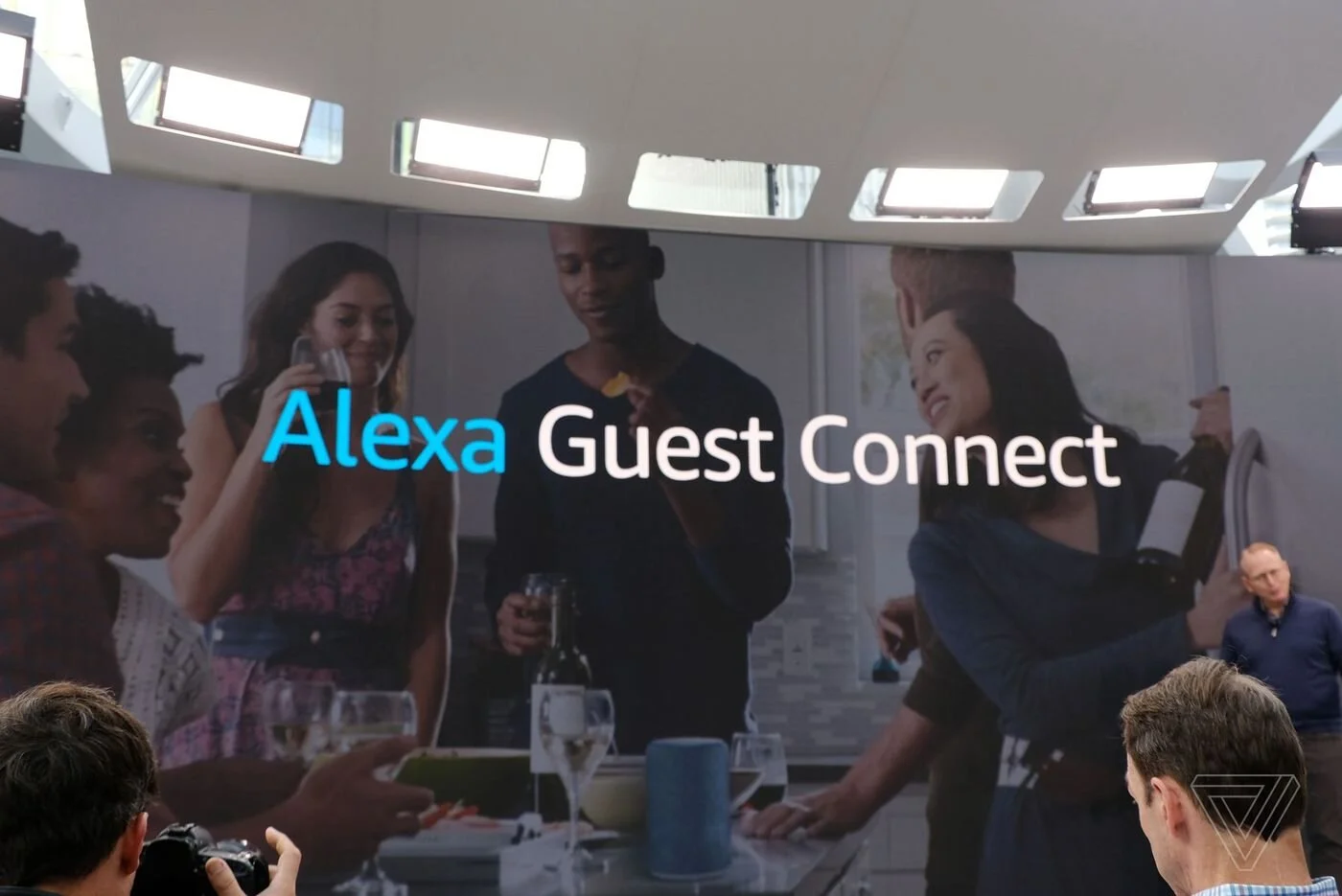
Guest Connect did not begin with a screen. It depended on Alexa recognizing and applying the right identity on a shared device — it lived in behavior, permissions, and device state rather than in a conventional graphical interface. That made the work hard to communicate through static wireframes alone.
The project required two product areas to agree on a flow involving identity, permissions, shared devices, and personal content. The written proposal had the answers, but the flow stayed too abstract to picture. Leadership review surfaced repeated questions the document technically addressed.
I proposed making it visible as a short scenario video. I wrote the script, coordinated teammates as participants, arranged access to a simulated home, filmed the end-to-end flow, and edited the final narrative. In the next review, leaders could picture the whole thing. The video created the agreement the written document had not, and unblocked the cross-team decisions Guest Connect depended on.
The video was not marketing added after the design. It was a functional design artifact used to validate the end-to-end model and help the team make a decision on Guest Connect itself.
- Step 1SceneEnter shared environment
The customer arrives in a space with a device they do not own.
Account stateHost deviceAn Echo belonging to someone else.
- Step 2SceneEstablish context
Alexa recognizes the relevant identity and conditions (via multiple technical solutions).
Account stateGuest requests accessThe guest asks to connect their account.
- Step 3ScenePersonal content available
With permission, the customer's content becomes accessible.
Account stateMutual confirmationBoth sides approve the connection.
- Step 4SceneActive state is clear
The customer understands which identity or device state is active.
Account stateGuest content availablePersonal music or news plays on the host's device.
- Step 5SceneEnd or transfer cleanly
The experience concludes or moves with no ambiguity left behind.
Account stateGuest disconnectsThe host's account returns to active state.
Illustrative diagram reconstructed for this portfolio. The top row shows the scenario as the customer experiences it; the bottom row shows the corresponding account state. Authentication implementation details are omitted.
Your music as you move between devices.
A listening session can span several devices and rooms. Customers needed to see what was playing, pick a destination, and move or extend playback without rebuilding the session. I led design for short- and medium-term media-portability concepts across voice and multimodal surfaces, defining the information architecture, interaction flows, visual patterns, edge states, and the relationship between active streams and available devices.
- 01Understand current state
Show which content is active and where it is playing.
- 02Choose a destination
Identify a compatible device or group through voice or touch.
- 03Resolve conflicts
Explain what will happen if the destination is already active or unavailable.
- 04Confirm the result
Make the new playback location clear without forcing the customer to infer state.
Portfolio-native flow. Internal wireframes and unshipped grouping concepts are not published.
Direct intent
Best when the customer already knows where the music should go.
Inspect and resolve
Best for inspecting active playback, comparing destinations, and resolving more complicated household states.
Voice and touch were not parallel versions of the same interface. Each modality handled a different part of the decision.
What the progression established.
Proactivity is an interaction contract
A proactive assistant must be contextual, understandable, restrained, and easy to stop.
Multimodal design is division of labor
Voice, touch, screens, and mobile confirmation should each handle the part of the task they are best suited to.
Match the artifact to the invisibility of the experience
For ambient and multimodal systems, scenarios, comics, videos, and state models can communicate the experience more accurately than a polished mockup.
- Alexa Guest Connect was publicly introduced as a way to access personal content on supported Echo devices with permission.
- Alexa supports moving audio between compatible Echo devices and groups.
- The broader product direction connected identity, personalization, and cross-device continuity.
- Built an end-to-end experimentation practice that integrated customer evidence, voice design, visual design, implementation, and iteration.
- Organized and co-facilitated a cross-functional vision sprint that turned experiment learning into a longer-term product direction.
- Designed music personalization and account-state experiences for Alexa Guest Connect.
- Led information architecture and interaction design for media-portability experiences across voice, touch, smart speakers, smart displays, and the Alexa app.
This work taught me to design across distributed systems where identity, context, modality, and platform boundaries shape what customers feel. I later carried those lessons into enterprise AI — first through Workday's Microsoft Copilot integration, then as the first product designer on Workday Agent System of Record.
In a live walkthrough, I can discuss additional iteration and collaboration detail while preserving confidential Amazon product information.
This case study uses public Amazon product information, official public imagery, and process diagrams recreated specifically for this portfolio. Internal metrics, customer quotations, proprietary tools, raw research materials, unreleased concepts, and confidential implementation details have been omitted.
Where the public information comes from.
- 01Amazon — Introducing Alexa Guest Connect
- 02PCMag — How to use someone else's Amazon Echo with Guest Connect
- 03About Amazon — New ways Alexa makes life simpler and more convenient
- 04Amazon — Move audio playback between compatible Echo devices
- 05Amazon — Multi-room audio
- 06Amazon — Alexa entertainment overview
- 07Amazon — Echo devices